Wednesday, June 14, 2023

A Brief History of Mount Jefferson in Easton, PA


By Sharon Gothard

William Parsons, surveyor, shoemaker, librarian, and much more, was sent by the Penn family to lay out the town of Easton. This was in 1752, when the county of Northampton was newly formed from the already established county of Bucks.

Thomas Penn selected the area of what was to become Easton, and the county seat. He elected Parsons to lay out the town.

Courtesy of Moravian Archives
 
If you look closely at the draught that Parsons drew, you will see one large outcrop along the what is now known as the Bushkill Creek. The letter A states that this place would make a good graveyard. That outcrop of a hill below the letter A is what we now call Mt. Jefferson.

 Peter Kachlein (1722 – 1789) was first to have this hill and had mills at the bottom of the mount. However, he never obtained a formal deed from the Penn family for this hill and property.

After his death, he willed the land to his daughter Elizabeth, married to Peter Ihrie.

 In honor of Thomas Jefferson becoming our third President, it was decided on January 1, 1801, to call the “hill that overhangs over the south side of the Bushkill”, MOUNT JEFFERSON. According to the American Eagle newspaper, many toasts were given and drank, accompanied by the discharge of a cannon up on this hill.

 Since the Ihrie’s still made no formal right to the land, Frederick Beates from Philadelphia, formally purchased the hill from the Penn’s for $35. In 1804, the Ihries repurchased it for $200. Peter Ihries willed the land to his sons, Benjamin and Ferdinand after his death in 1827.

 Over the years, there were many occasions to fire the cannon on Mt. Jefferson and Napoleon (Poly) Patier was the cannoneer. On the 1850 map of Easton in the Marx Room, there is a “Cannon House” on Mt. Jefferson, along with a “Negro Shanty” at the base of the hill, possibly to take care the burial ground of the Blacks adjacent to the German Reform Cemetery.

 Another celebration, Easton’s militia went down the Delaware River in Durham boats to welcome General Lafayette on his visit in 1824. Music played, crowds cheered and cannons were fired from Mt. Jefferson to celebrate his arrival.

 In 1853, Ferdinand Ihrie sold his half of Mt. Jefferson to his brother Benjamin.

 “Some malicious scoundrel, in whose bosom the fire of patriotism has become extinct, if it ever burned at all, spiked the cannon on Mt. Jefferson, on Thursday night, which prevented the firing of a national salute on the 22d.” Easton Express February 23, 1856

 In the Easton Argus, February 25, 1858, “Washington’s birthday was appropriately celebrated in our Borough by a military parade and cannon firing from Mt. Jefferson. “Young America” is not deficient in patriotism.”

 A thirty-three guns salute was fired from Mt. Jefferson in honor of the admission of Oregon as a state on February 14, 1859.

When Jacob Dachrodt was mustered out of the First Pennsylvania Regiment on July 26, 1861, he and few other volunteers, returned to a “rousing reception in Easton.” Church bells rang and cannons were fired from Mt. Jefferson.

Firing of Cannon off Mt. Jefferson (possibly Poly)


                                           Courtesy of Library Company of Philadelphia (Circa 1870)


In 1869, Benjamin Ihrie sold most of Mt. Jefferson to his relative, Stephen Van Buren Kachline, an Easton lawyer. Approximately 1870,  Kachline must have built a home on Mt. Jefferson as it is listed on the 1874 Northampton County Atlas Map by Beers. Interesting note, John D. Sigman who was related to the Kachline’s on his mother side, had built a house on the “cliff” of Mt. Jefferson overlooking North West St. and downtown Easton. There is nothing left of this home, it was torn down  @1966 after being vacant for too long a time.

 In 1879 the property went up for Sheriff Sale. Annie Kachline, Stephen’s wife, bought it back for $2,625 and kept the title in her name until she sold it to Anna M. (Whitesell) Steckel for $7,000 in 1896. Anna was married to Henry Steckel, lawyer.


     Courtesy from Miles Dechant circa late 1890’s 

 In the 1880 Federal Census, the Kachlines were living on “Mt. Jefferson.” By 1882, Stephen passed away. Annie and her family were still living at Mt. Jefferson in the 1890 Census Directory.

 On the 1897 Sanborn Fire map, it has a house on the property and several other buildings on Mt. Jefferson. One of the buildings has Paper Box Factory. Talking to Miles Dechant, a descendant of the Kachline’s, Stephen Kachlines’ son, John Franklin had the Box Factory. In later census’s, he is listed as a paper box manufacturer living in Reading, PA.

  Courtesy of Miles Dechant


 Original entry home with larger home in the back ground – Courtesy of Miles Dechant               Later renovations of entry house                                           


 In 1914, Anna Steckel, wife of Henry, died. The property was willed mainly to her husband. 


    The front porch has been enclosed or winterized.


Sometime between 1916 to 1918, Steckel made improvements to the property, by adding a double garage.


Courtesy of the Easton Patch

Henry Steckel died in 1919 at the age of 90. In his will, Henry divided the Mt. Jefferson property into three pieces. His daughter Jennie, was given the main house and after her death, it was to go to Henry's grandson, Henry F. Steckel II. His son, Daniel, received "his present residence on North Fifth street". This house was given to Daniel and his wife as a wedding gift in 1912 and still remains at the entrance to the Mt. Jefferson property. Many people confuse this house with the original larger Kachline/Steckel house.
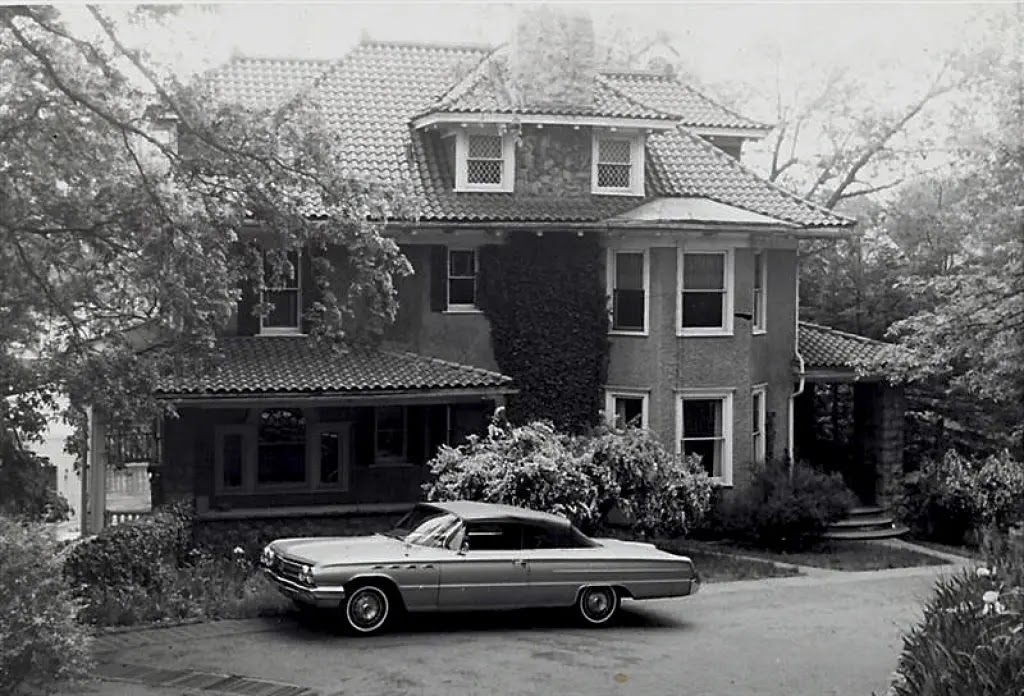


   Side view of entry house                                                 Both photos courtesy of the Easton Patch


Jennie Steckel and a companion, lived in the Steckel Main House until her death in 1927. It is thought that the main house was either torn down or had burned, around the 1930’s as it is definitely gone and does not appear on the 1957 Sanborn Fire Map.


Today, Mount Jefferson is nothing but overgrowth, trees and remnants of where buildings and the home stood.

 Daniel Steckel lived in the “entry house” until his death in 1923. His wife, Mabel (Marnie) Steckel lived in the house until she went to a retirement home in 1963 and passed away at the retirement home  in 1972.

 In 1962, Hugh Moore Jr. and his brother, Craig were given an option to purchase Mt. Jefferson. They sold their option the next year to Rocks Construction, Inc., who had plans to build 100 apartments on the hill.  By 1972, the project was abandoned.

 The property went through a few hands, with hopes of restoring the “entry house”. Today, although there is a smidgen of beauty to the once grand place, some neglect can be seen.

 There are still many mysteries to the hill known as Bushkill Hill or Mount Jefferson. 

Many thanks to Richard Hope and his fabulous Walking Easton database. If you are looking for a more detailed report of what Hope put together, it can be found in the Marx Room.

Special thanks to William Grant, Frederick Bond and Miles Dechant.


Wednesday, May 10, 2023

Catharine S. Drake Room at the Easton Area Public Library


Miss Catharine Stewart Drake

1828 - 1906


Catharine Drake was born in Easton, PA on January 3, 1828. Her parents were John Drake and Margaret (Stewart). John engaged in the mercantile business, adding to the family wealth.

Catharine’s life was filled with deeds of kindness and acts of charity. She was a contributor to the Easton Hospital and their nurse’s home. The Easton Home for Friendless Children, Lafayette College, along with the Easton Home for Aged and Infirm Women, all received generous donations from Miss Drake.

 Catharine suffered a broken femur four years before her death. Although she was mainly bed ridden, it was said her giving demeanor never changed. Miss Drake had never married. 

In Catharine’s will, she bequeathed $10,000 to the just built Easton Public Library. This money was given to the Easton School District to be held in trust and only the interest could be used.

In 1928, the Easton Library opened a new room, calling it The Catharine Drake Memorial Technology Room. This room was dedicated to all subjects pertaining to “applied science, business, engineering, advertising and kindred subjects”. 

 In the Easton Area Public Library Board of Trustees minutes, January 31, 1968, it was suggested; that the income from the Catharine S. Drake Fund be put in a separate account known as the "Catharine S. Drake Fund" and that this fund be used toward the meeting room named in her honor

Saturday, April 22, 2023

THE FROCK COAT AFFAIR


by Rory Morgan


In 1864, a semi-fictional book entitled Red-Tape and Pigeon-Hole Generals appeared. The author remained anonymous, simply calling himself "A Citizen-Soldier". It used dark humor and thinly-disguised characters to blast the  “ . . . drunkenness, half-heartedness, and senseless routine  . . .” among the officers of the Army of the Potomac, the Union’s most well-known fighting force.


The book was particularly critical of Union general Andrew A. Humphreys - portrayed as "Old Pigey" in the book, - for his drinking and his harshness as a commander. Humphreys was a career soldier; a “Regular”, as they were called in the Civil War. He was a Philadelphia native from a prominent family. He had attended the quasi-military academy of Nazareth Hall and then the U.S. Military Academy at West Point, NY, graduating in 1831. He spent most of his pre-war career in the  Army’s Corps of Engineers. It turned out to be an ideal place for him in peacetime; he served there until the outbreak of the Civil War. His work was mostly in surveying, mapping and scientific work. It did  not include any significant combat experience, nor did it include leading any significant numbers of soldiers.


The book's author was eventually determined to be an Easton attorney, William H. Armstrong. He was a Lieutenant Colonel, serving as second-in-command of the 129th Pennsylvania Volunteer Infantry regiment. Armstrong was a native of the Lewisburg (PA) area and came to Easton to study law. When his education was completed, he stayed in Easton and began practicing law. He was active in one of Easton’s several pre-war militia units, the Easton Invincibles. When the Civil War erupted in April 1861, he helped to recruit the 1st Pennsylvania Volunteer Infantry regiment, which had several companies of Northampton County men. (Companies, identified by letter, were units of approximately 100 men; ten companies made up a regiment.) 


The commander of the regiment, with the rank of Colonel, was prominent Easton citizen Samuel Yohe. Company captains from Easton included Armstrong (commander of Company C), Jacob Dachradt, Charles Heckman, and Ferdinand Bell. Like most of the early Union volunteer units, the 1st Pennsylvania was a three-month regiment; virtually no one on either side anticipated a war that would last for years. The regiment’s short service, from April to September, was uneventful. After 90 days, its soldiers, including Armstrong, were “mustered out” to return to their homes. They were now veterans.


By the summer of 1862, the war was not going well for the Union; the Army’s need for additional manpower was obvious. New Pennsylvania regiments, to serve for nine months, were recruited in Northampton and other counties – one was the 129th Pennsylvania Volunteer Infantry. Armstrong helped to recruit soldiers for the new regiment. Many of them were veterans of the old 1st Pennsylvania; they now patriotically signed up for a second tour of duty). Armstrong became second-in-command of the regiment, with the rank of Lieutenant Colonel. The 129th was assigned to the 3rd Division of the 5th Corps. which was under the command of Humphreys. 


Soon after the regiment was organized, it was dispatched to Sharpsburg, MD, where the Battle of Antietam was under way. The regiment’s arrival was, however, just a bit too late to participate. So, its initial combat experience was at the Battle of Fredericksburg (VA), in December of 1862. The battle was a disaster for the Union troops, poorly planned and poorly executed, The 129th was among the many regiments ordered to attack uphill; the Confederates at the top were sheltered behind a stone wall. As might be expected, casualties were heavy. Armstrong’s horse was shot from under him during the battle. (The citizens of Easton later presented him with a new horse.) Six months later, at the Battle of Chancellorsville, Armstrong was twice captured, quickly escaping both times. 


Away from the battlefield, there was consistent tension between General Humphreys and several of the volunteer officers under him, including Armstrong. The tension was aggravated when Armstrong, no stranger to a courtroom, successfully defended an enlisted man in a court-martial proceeding initiated by Humphreys. In the spring of 1863, the tension finally erupted in the so-called “frock coat mutiny." Frock coats were heavy Army dress coats, primarily used for parades and other formal occasions. For whatever reason, the soldiers of the 129th did not have them, so, in early 1863, the Army issued orders requiring them to “draw” frock coats. In line with Army policy, the coats would be charged against the soldiers’ uniform allowance; if there was not enough money in a soldier’s account, their regular pay would be charged.


Armstrong, joined by his superior, Colonel Jacob Frick, thought that the expense was unnecessary, in view of the fact that the regiment’s enlistments would expire in the spring, and that the coats would add to the burden carried by soldiers on the march. Suspecting that the Army was trying to bail out a contractor who was stuck with excess inventory, Frick and Armstrong applied for an exemption to the requirement - but  General Humphreys refused their request.  


Planning to appeal Humphrey’s decision, Armstrong and Frick didn’t issue the necessary requisitions for the coats. The General then filed charges against Armstrong and Frick. He had them arrested and held for a court-martial. Armstrong, in particular, seems to have been held in abysmal conditions. Following the trial, he and Frick were “cashiered",meaning that they were dismissed from the service. Soon however, the two officers were reinstated to their ranks and positions; they completed their service on May 18,1863, when they and the rest of the 129th were mustered out.   


After that,  Armstrong was appointed Deputy Secretary of the Commonwealth by Pennsylvania governor Andrew Curtin. Eventually, he returned to Easton to practice law. But, as one of the county judges noted in a memorial when Armstrong died, “Many of his old clients were dead and the rest were scattered . . .”  He wasn’t able to rebuild his old practice to its previous level.


His service not only caused significant damage to his professional life, but also to his physical condition. The decline in his health, blamed on the conditions under which he was held while under arrest, culminated in total blindness during the last two years of his life.


Armstrong died on April 7, 1896 and is buried in Easton Cemetery, Plot C-173. His wife, Myra Chidsey Armstrong, and their three sons survived him.


                                                                    A . A. Humphreys